


Introduction
Machine learning looks intimidating from the outside. Endless math, dense papers, and a hundred different roadmaps online make it hard to know where to start.
This guide cuts through the noise. It gives ML Learners a practical, three-stage path that takes you from writing your first few lines of Python to deploying a real, working ML application.
You won’t find vague advice here. Every section points to a specific skill, project, or resource you can act on today.
Essential Prerequisite Checklist
Most beginners overload on theory before they ever open a code editor. That approach kills momentum fast. Here’s what you actually need before you start building.
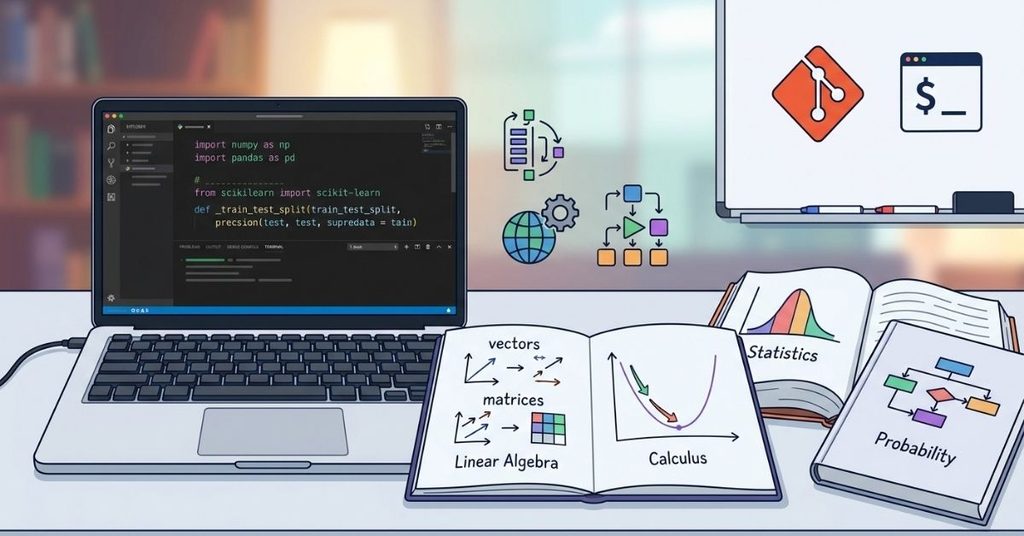
Programming Foundations
Python dominates the ML industry today. It powers most production systems, has the largest ecosystem of libraries, and connects easily to web frameworks, cloud platforms, and deployment tools.
R still holds ground in academic statistics and specialized research fields. But if your goal is a career as an ML engineer, Python gives you a much wider range of opportunities.
Focus your early weeks on:
- Core Python syntax: loops, functions, classes, and error handling
- NumPy for numerical operations and array manipulation
- Pandas for data cleaning and manipulation
- Scikit-learn for your first models
- Basic Git and command-line skills: you’ll need both for every project ahead
Skip R unless a specific job or research path requires it.
Practical Math Minimum
You don’t need a math degree to start ML. You need enough intuition to understand what your models are doing.
| Math Area | What to Learn | Why It Matters |
| Linear Algebra | Vectors, matrices, dot products | Powers how models process data and weights |
| Statistics | Mean, variance, distributions, hypothesis testing | Helps you interpret data and model results correctly |
| Calculus | Derivatives, gradients | Explains how models learn through optimization |
| Probability | Bayes’ theorem, conditional probability | Underlies classification and probabilistic models |
Learn this math alongside code, not before it. Watching a gradient descent algorithm run in Python teaches you more about derivatives than a semester of pure calculus theory ever will.
The 3-Stage Progression Framework
Generic course advice tells you to master theory, then practice. That order works against how most people actually learn technical skills. This framework flips it.

Stage 1: Code First, Math Second
Start with high-level libraries like Scikit-learn. Build a working classifier or regression model before you understand every equation behind it. This builds intuition and momentum early, and it keeps you motivated because you see results fast.
Stage 2: Deconstruct and Rebuild
Once you’re comfortable using ML tools, open them up. Rebuild classic algorithms linear regression, k-nearest neighbors, a basic neural network using only NumPy. This step forces you to understand the math because you’re implementing it yourself, not just calling a function.
Stage 3: Production Deployment
Wrap your models in a real application. Use FastAPI to serve predictions, Docker to containerize your app, and a simple CI/CD pipeline to simulate how ML systems actually get deployed in industry. This stage separates hobbyists from job-ready engineers.
Each stage builds directly on the last. Skipping ahead, especially straight to Stage 3, leaves gaps that show up in technical interviews.
Overcoming “Tutorial Hell”
Almost every ML learner hits a point where they’ve watched dozens of tutorials but can’t build anything on their own. This pattern, often called “tutorial hell,” happens because tutorials give you the feeling of progress without the friction that actual learning requires.
The trap usually shows up in one of these forms:
- Following along without typing code independently
- Restarting a new course every time a topic gets hard
- Copying code without asking why it works
- Avoiding projects because they feel too open-ended
The fix isn’t more tutorials. It’s smaller, self-directed projects with no step-by-step guide. Pick a public dataset, set a goal (“predict housing prices,” “classify these images”), and build toward it using documentation and Stack Overflow instead of a video walkthrough. The struggle is where the learning happens.
A practical rule: for every hour of tutorial content you watch, spend at least two hours building something without one.
Portfolio Projects That Build ML Learner Competency
Employers don’t hire based on completed courses. You are hired based on your ability to build. A strong portfolio, mapped to the three-stage framework above, does more for your job search than any certificate.
Stage 1 Project: Exploratory Data Analysis and Baseline Models
Pick a dataset from Kaggle or the UCI Machine Learning Repository. Clean the data, visualize key patterns, and build a baseline model using Scikit-learn. Document your process in a Jupyter notebook with clear explanations, not just code cells.
This project shows you can handle real, messy data the single most common gap in beginner portfolios.
Stage 2 Project: Custom Algorithm Implementation
Rebuild an algorithm from scratch using only NumPy. A logistic regression classifier or a simple neural network with backpropagation works well here. Compare your implementation’s performance against Scikit-learn’s version and explain any differences.
This project proves you understand the mechanics, not just the API calls.
Stage 3 Project: Deployed ML Application with API
Take a model you’ve built and turn it into something usable. Wrap it in a FastAPI backend, containerize it with Docker, and deploy it to a cloud platform. An end-to-end sentiment analysis tool or an image classifier with a simple front end works well.
This project matters most to hiring managers. It shows you can take a model from a notebook into a working product, the exact skill most ML jobs require day to day. For a practical example of how machine learning can analyze language patterns, explore AI fingerprint detection and language patterns.
Top Free vs. Paid Learning Resources for ML Beginners
You don’t need to spend money to build strong ML fundamentals, but paid resources can save time and offer structure that free content often lacks.
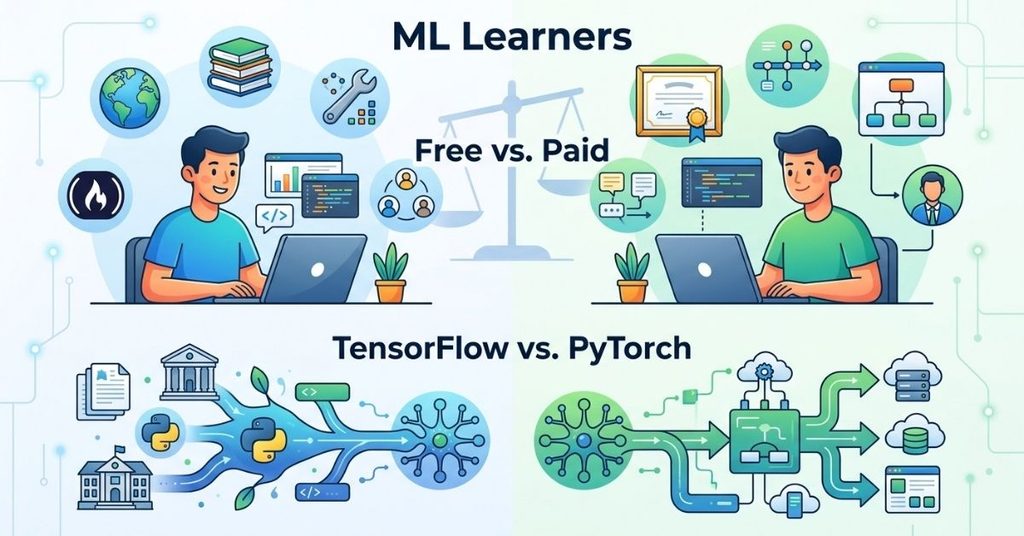
| Resource Type | Free Options | Paid Options | Best For |
| Courses | freeCodeCamp, Google’s ML Crash Course | Coursera (Andrew Ng’s ML/DL specializations) | Structured, guided learning |
| Practice Datasets | Kaggle, UCI ML Repository | — | Hands-on project work |
| Coding Practice | Kaggle Notebooks, Google Colab | DataCamp | Interactive, guided coding |
| Deep Dives | Fast.ai, PyTorch/TensorFlow docs | Udacity Nanodegrees | Framework-specific mastery |
| Community Support | Reddit (r/MachineLearning), Discord servers | Mentorship programs | Feedback and accountability |
A practical mix: use free resources for foundational learning, and reserve paid options for structured programs when you need deadlines and accountability to stay consistent.
TensorFlow vs. PyTorch for Beginners
Both frameworks work well for beginners, but they serve slightly different needs.
PyTorch tends to feel more intuitive for people new to deep learning because its syntax stays close to standard Python. It’s also the dominant framework in research and most academic papers.
TensorFlow, especially through its Keras API, offers strong production tooling and integrates cleanly with deployment pipelines, which matters once you reach Stage 3 of the framework above.
If you’re unsure, start with PyTorch for learning and experimentation. Pick up TensorFlow later if a specific job or project calls for it.
Common Mistakes ML Learners Should Avoid
A few patterns show up again and again among beginners who stall out or burn out:
- Chasing every new tool. Constantly switching between frameworks, courses, and tutorials prevents deep learning in any one of them.
- Skipping the math entirely. You don’t need to master it upfront, but avoiding it completely leaves gaps that surface in interviews and advanced projects.
- Building only toy projects. Iris classification and MNIST digit recognition are fine starting points, but a portfolio full of only these signals limited real-world exposure.
- Ignoring model evaluation. In most cases, accuracy alone does not tell the whole story. Learn precision, recall, F1 score, and confusion matrices early, and use them to judge your models honestly.
- Underestimating hardware needs. Most learning projects run fine on a standard laptop, but deep learning work benefits from cloud GPU access (Google Colab, Kaggle Notebooks, or a cloud provider’s free tier) once your models grow larger.
Transitioning from Software Developer to ML Engineer
If you already write code professionally, you hold a real advantage. Your existing skills in version control, testing, debugging, and system design transfer directly into ML engineering.

Focus your transition on:
- Building statistical and mathematical intuition through the Stage 1 approach above
- Learning how ML models fit into existing software systems (APIs, databases, pipelines)
- Practicing the specific workflow of data preprocessing, model training, and evaluation
- Studying MLOps concepts, since production Machine learning work overlaps heavily with the DevOps skills you likely already have
Many software developers move into ML engineering faster than complete beginners specifically because deployment and system design are often the hardest part for career-changers and already feel familiar.
Frequently Asked Questions
How Long Does It Take to Become Job-Ready for a Machine Learning Career?
It depends heavily on your background and consistency, but most learners starting from scratch need six months to a year of steady, project-focused work to reach a junior-level standard.
Is a College Degree Required to Start a Career in Machine Learning?
No. A strong portfolio, demonstrated project experience, and solid fundamentals matter more to most employers than a specific degree, though a technical background does help.
Should I learn math before or after coding?
Learn them together. Use Stage 1 of the framework above to build coding confidence first, then deepen your math understanding as you rebuild algorithms in Stage 2.
What’s the biggest mistake ML beginners make?
Staying in tutorial mode too long. Real learning happens when you build projects without a step-by-step guide to follow.
Which Is Better for Machine Learning: Python or R?
Python, for most learners. It has a larger ecosystem, wider industry adoption, and better support for deployment and production work.
How Many Machine Learning Projects Should You Include in a Strong Portfolio?
Three well-built, end-to-end projects one from each stage of the framework demonstrate more competency than ten shallow, tutorial-based projects.
Conclusion
Machine learning rewards learners who build before they master theory, and who treat deployment as part of the learning process rather than an afterthought.
The three-stage framework gives ML Learners a clear path: start coding with high-level tools, rebuild the fundamentals from scratch, then deploy your work as a real application.
Skip the trap of endless tutorials. Pick a dataset, set a goal, and start building today. Progress in machine learning comes from friction, not from watching one more video.

I’m Qasim Ali, the Founder and Technology Writer at TechRised, with 10+ years of experience and a strong academic background in technology and emerging digital innovations. My expertise spans Generative AI, AI Automation, Robotics, Computer Vision, and Machine Learning. I specialize in researching emerging technologies, analyzing industry trends, and transforming complex technical concepts into clear, practical, and reliable insights. Through TechRised, I share research-driven content to help readers understand the latest advancements in AI and the technologies shaping the future.