


Introduction
Healthcare brands now use AI-generated doctors and patients for healthcare marketing compliance, along with synthetic clinical scenes in ads. The technology cuts production costs and speeds up campaigns. But it also creates real legal exposure under FTC, HIPAA, FDA, and state medical board rules.
This guide breaks down where synthetic media crosses legal lines, how regulators evaluate these campaigns, and what a defensible compliance process looks like.
A quick note before you read further: the frameworks, sample scenarios, and risk ratings below reflect general compliance principles and illustrative examples, not verbatim regulatory text or a published study. Always confirm current requirements with your legal counsel before launching a campaign.
Why Healthcare Marketers Turn to AI-Generated Imagery
Marketing teams adopt AI imagery for a few practical reasons.
- Cost. A single AI-generated image costs a fraction of a photo shoot with licensed talent, model releases, and medical props.
- Speed. Teams generate dozens of variations in hours instead of scheduling shoots weeks in advance.
- Representation. AI tools let brands depict a wider range of patient demographics without recruiting new models for every campaign.
These advantages come with a hidden cost: synthetic realism blurs the line between marketing and impersonation. A photorealistic AI doctor in a white coat can look and sound like a real, licensed physician giving medical advice. Regulators treat that resemblance as a legal issue, not a design choice.
Healthcare Marketing Compliance for AI-Generated Doctors and Patients
Several agencies and legal frameworks intersect when a healthcare brand uses synthetic media.

FTC Rules on Truth in Advertising
The FTC enforces Section 5 of the FTC Act, which prohibits deceptive and unfair advertising practices. An ad that leads a reasonable viewer to believe an AI-generated figure is a real, licensed physician giving genuine medical guidance likely violates this standard. The FTC’s endorsement guides also require disclosure when an ad uses a persona that isn’t what it appears to be.
HIPAA and Data Privacy Considerations
HIPAA protects real patients’ Protected Health Information (PHI). Problems arise when a generative model trains on datasets that include real patient photos, medical records, or identifiable biometric data without consent. Even if the final output looks “synthetic,” the training pipeline behind it can carry legal risk if it relied on unauthorized PHI.
FDA and Pharma Advertising Rules
Pharmaceutical ads must include fair balance — a clear presentation of risks alongside benefits. An AI-generated spokesperson doesn’t exempt a pharma brand from this requirement. If anything, regulators scrutinize synthetic spokespeople more closely, since the “expert” delivering the message doesn’t exist and can’t be held accountable the way a real physician can.
State Medical Boards and Corporate Practice of Medicine
Most states restrict who can give medical advice or recommend treatment. An AI avatar that recommends a specific therapy or prescription treads into practicing medicine without a license, even though no license exists to revoke. State medical boards and attorneys general have the authority to act on this kind of impersonation.
Real Doctors vs. AI Avatars: A Compliance Matrix
Not every use of AI imagery carries the same risk. Context determines whether a synthetic doctor or patient crosses a legal line.
| Use Case | Legal Risk | Why |
| AI patient image for a blog header (no claims) | Low | No implied credential, no medical advice given |
| AI-generated “diverse patient” testimonial without disclosure | Moderate-High | Implies a real person’s experience with a treatment |
| AI doctor avatar reciting general health tips | Moderate | Viewers may assume licensed expertise |
| AI doctor avatar recommending a specific drug or treatment | Critical | Impersonates a licensed provider; may violate FTC and state medical board rules |
| Fully disclosed AI persona with clear “not a licensed physician” label | Low-Moderate | Disclosure reduces but doesn’t eliminate risk |
Red lines an AI-generated medical persona should never cross:
- Recommending a specific drug, dosage, or treatment plan
- Claiming board certification or a medical license
- Appearing without any disclosure of its synthetic nature
- Delivering clinical guidance that a real patient might act on without seeing an actual provider
A Framework for Vetting AI Medical Imagery Before Launch
Compliance teams need a repeatable process, not a one-off legal review. Below is a four-part framework you can adapt for your own vetting pipeline. Treat it as a starting template, not a certified industry standard.

Step 1: Check Provider Identity
Ask whether the image or video could be mistaken for a real, credentialed practitioner. If a reasonable viewer would assume the person is a licensed doctor, the ad needs a prominent disclosure or a redesign.
Step 2: Verify Patient Privacy and Data Sourcing
Confirm the generative tool’s training data doesn’t include non-consensual patient images or PHI. Ask your AI vendor directly about data provenance and get it in writing in your contract.
Step 3: Audit Clinical and Contextual Accuracy
Check the small details: proper PPE, correct medical equipment, realistic clinical settings. Errors here don’t just look unprofessional; they undermine the ad’s credibility and can draw unwanted scrutiny.
The same attention to detail applies to AI-generated content across different use cases, where output quality and contextual accuracy can affect how audiences interpret synthetic media.
Step 4: Confirm Disclosure Placement
Verify that disclosure text (“AI-Generated Persona Not a Licensed Physician”) sits in a conspicuous location, in readable font size, with enough contrast and display time for viewers to actually notice it.
FTC-Compliant Disclosure Guidelines
Disclosures only count if a viewer can actually see and understand them. The FTC’s general guidance on “clear and conspicuous” disclosures applies directly here.

Wording: Use plain language. Something like “Virtually Generated Model Not a Licensed Physician” works better than vague phrases like “digitally enhanced” or “AI-assisted.”
Placement: Put the disclosure near the claim it modifies, not buried in fine print at the bottom of a page.
Visual design: Use a font size and color contrast that a viewer with average eyesight can read without zooming in. For video, hold the disclosure on screen long enough to read it twice.
Duration for video and social ads: A disclosure that flashes for half a second doesn’t meet the “conspicuous” bar. Match the display time to the pace of the surrounding content.
Illustrative Scenarios: Where Campaigns Go Wrong
The following examples describe the kind of risk pattern compliance teams commonly encounter. They’re composite illustrations, not citations of specific enforcement actions.
Scenario: The unlabeled AI physician.
A digital health startup runs a video ad with a hyper-realistic AI avatar in a white coat, recommending a specific therapy. No disclosure appears anywhere in the ad. Viewers reasonably assume they’re watching a licensed physician endorse a treatment. This pattern maps directly onto FTC deceptive-advertising concerns, since the persona implies credentials that don’t exist.
Scenario: Scraped patient likenesses.
A hospital system generates “diverse patient testimonial” images for an oncology landing page. The AI tool was trained on public internet images, and one output closely resembles a real, identifiable person who never consented to appear in a medical ad. This exposes the hospital to right-of-publicity claims and, depending on the state, biometric privacy statutes.
Both scenarios share a root cause: nobody ran a structured legal review before the campaign went live.
Risk Mitigation Checklist for Marketing Teams
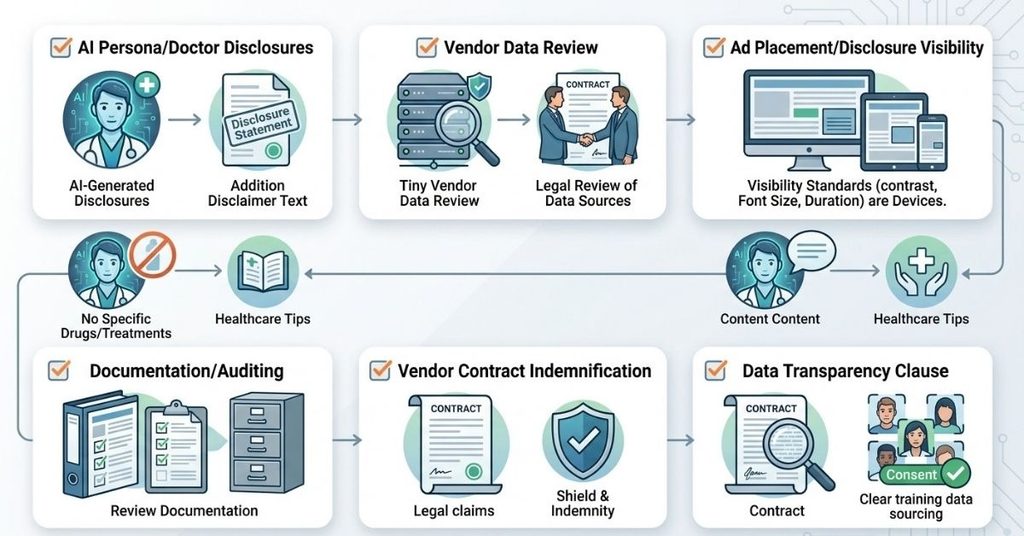
Before launching any campaign with AI-generated medical personas, confirm the following:
- Does the persona imply a real medical credential? If yes, add a disclosure or remove the claim.
- Has legal counsel confirmed the AI vendor’s data sourcing practices?
- Does the disclosure meet font size, contrast, and duration standards for the platform?
- Does the ad avoid specific treatment or drug recommendations from the AI persona?
- Have you documented the review in case a regulator asks for it later?
- Does your AI vendor contract include indemnification language for right-of-publicity or biometric privacy claims?
Add a vendor contract clause requiring the AI provider to disclose training data sources and warrant that outputs don’t replicate identifiable real individuals without consent. This single clause closes one of the biggest gaps compliance teams miss.
FAQs
Are synthetic patient images HIPAA compliant for website ads?
It depends on the training data, not the output. If the generative model trained on real patient images or records without proper authorization, the underlying process can violate HIPAA even if the final image looks fully synthetic.
What are the legal risks of using AI-generated doctors in telehealth ad campaigns?
The main risks are FTC deceptive-advertising violations and, in some states, practicing-medicine-without-a-license concerns if the avatar recommends specific treatments.
How should a brand disclose AI-generated medical imagery in advertising?
Use plain, visible language near the claim itself, for example, “AI-Generated Persona Not a Licensed Physician ” with a font size, contrast, and display duration a typical viewer can actually read.
Can an AI-generated physician legally recommend medical treatments?
No. Recommending specific treatments or drugs crosses into practicing medicine, and no AI persona holds a medical license. This applies regardless of how realistic the persona looks.
Do FDA rules apply to synthetic physician spokespersons in pharma ads?
Yes. Fair balance requirements for risk and benefit information still apply, and pharma brands remain fully accountable for what an AI spokesperson says, even though the spokesperson isn’t a real person.
What’s the ethical concern with fake patient testimonials in health ads?
Fabricated patient stories can mislead viewers into believing a treatment produced specific real-world results. Without clear labeling, this crosses from marketing into deception, separate from any regulatory violation.
Conclusion
AI-generated doctors and patients offer real production advantages, but the legal risk scales with how realistic and unlabeled the content is. The line that matters most: does the persona imply a credential or clinical claim it can’t back up?
Build a repeatable vetting process, get disclosure language right, and put data-sourcing warranties in your vendor contracts. Compliance review at that Level protects the brand and protects patients who might otherwise mistake a synthetic doctor for real medical guidance.

I’m Qasim Ali, the Founder and Technology Writer at TechRised, with 10+ years of experience and a strong academic background in technology and emerging digital innovations. My expertise spans Generative AI, AI Automation, Robotics, Computer Vision, and Machine Learning. I specialize in researching emerging technologies, analyzing industry trends, and transforming complex technical concepts into clear, practical, and reliable insights. Through TechRised, I share research-driven content to help readers understand the latest advancements in AI and the technologies shaping the future.