


Introduction
Painting contractors lose jobs before the phone even rings back. A homeowner fills out a form, waits three hours for a callback, and books with the company that answered first. Speed decides more estimates than skill does.
This guide breaks down how an AI lead-generation automation workflow for painting trade businesses can close that gap for residential and commercial painting businesses.
You’ll see the exact workflow structure, real benchmark data, a case study from a three-crew painting firm, and a practical way to start building this system yourself.
Why Painting Contractors Need AI-Powered Lead Automation
Painting is a relationship business, but it runs on logistics. Every missed callback, slow quote, or forgotten follow-up costs real money. Manual lead handling works fine at low volume. It breaks down the moment ad spend picks up or referral season hits.

AI lead generation automation solves three problems at once:
- Leads are responded to in seconds, not hours.
- It filters out bad-fit jobs before they eat an estimator’s afternoon.
- It keeps every prospect warm until they say yes or no.
None of this replaces your sales team. It removes the busywork that keeps your sales team from selling.
The Painting Industry’s Speed-to-Lead Problem
Most painting businesses still treat lead response like an afterthought. A lead comes in from a Google Local Services ad or a website form, and it sits in an inbox until someone has a free moment. That free moment often comes hours later.
Homeowners requesting painting estimates usually contact three to five contractors at once. The first company to respond gets the first shot at the job, often before a truck even shows up.
Benchmark Data Every Painting Business Owner Should Know
Response time isn’t a soft metric. It’s the single biggest lever in painting lead conversion.
Painting leads contacted within 5 minutes convert at 3.8x the rate of leads contacted after 30 minutes. That gap only widens after the first hour. A homeowner who submits a form at 9 a.m. and hears nothing by noon has usually already talked to a competitor.
This pattern shows up hardest during peak painting season. Between March and September, homeowners compare quotes fast and decide fast. A slow response doesn’t just lose a job; it signals disorganization, and painting is a trade where trust matters as much as price.
| Response Time | Estimated Conversion Multiplier | Typical Homeowner Behavior |
| Under 5 minutes | 3.8x baseline | Books the estimate, stops shopping |
| 5–30 minutes | 2.1x baseline | Still comparing, but engaged |
| 30 minutes–2 hours | 1.3x baseline | Likely mid-conversation with a competitor |
| 2+ hours | Baseline (1x) | Often already booked elsewhere |
The takeaway is simple: the fastest response usually wins the job, not the lowest quote.
The 4-Stage Painting AI Lead Workflow Architecture
A working automation system for a painting business breaks down into four connected stages. Each stage hands off cleanly to the next, so no lead falls through a gap between a web form and a scheduled estimate.
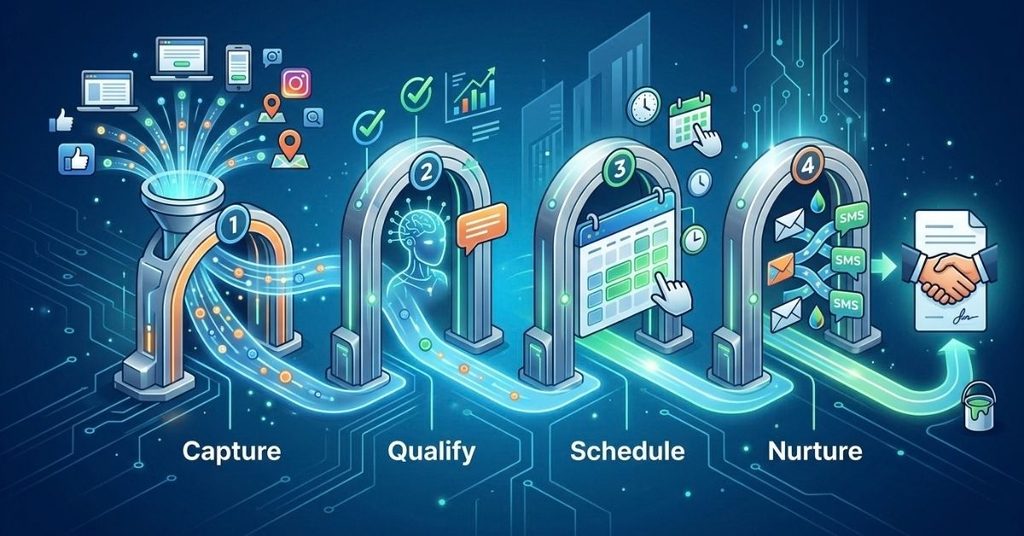
Stage 1: Capture
The system pulls leads from every channel into one place. That means web forms, Facebook and Instagram lead ads, and Google Local Services leads all feed into a single pipeline instead of scattering across inboxes, text threads, and ad platform dashboards.
Tools like Zapier or Make.com typically handle this connection layer, linking ad platforms and forms to a CRM such as HubSpot, Jobber, or GoHighLevel.
Stage 2: Qualify
The moment a lead lands, an AI-driven text or chat exchange asks the questions your estimator would ask anyway. Businesses using AI-generated content in customer-facing marketing should also review disclosure and compliance requirements, especially when AI-generated people or healthcare-style scenarios appear in promotional materials.
- What type of project is this: interior, exterior, or both?
- Roughly what square footage or room count?
- What’s the timeline: this month, this season, or just researching?
- Residential or commercial?
This step happens within a minute of lead capture, not hours later. It also sorts serious buyers from window-shoppers before anyone drives to a site.
Stage 3: Schedule
Once a lead qualifies, the workflow syncs directly with the estimator’s calendar. The homeowner picks an open slot without a back-and-forth phone tag session. This step alone removes one of the biggest time drains in a painting business’s admin workload.
Stage 4: Nurture
Not every qualified lead books an estimate immediately, and not every estimate turns into a signed contract right away. The nurture stage sends automated, spaced-out follow-ups via a mix of SMS and email until the homeowner makes a decision and that decision gets logged in the CRM.
This stops leads from going cold simply because no one remembered to follow up on day nine.
Case Study: Scaling Exterior Estimates Without Adding Admin Staff
A mid-sized painting company running three crews adopted this exact workflow to handle its growing exterior estimate volume.
Before automation, the office manager fielded every inbound lead by phone or text, manually screening each one. Estimators regularly drove out to quote jobs that turned out to be small touch-up work rather than full exterior repaints a mismatch that cost hours every week.
After deploying an AI-driven qualification bot at the front of the pipeline, three shifts showed up clearly in the numbers:
Fewer wasted site visits. The bot filtered out small-repair inquiries before they reached the estimator’s calendar, so on-site visits skewed heavily toward full exterior and larger interior jobs.
Lower admin hours. The office manager stopped manually texting or calling every new lead. Automated qualification and scheduling handled the repetitive first-contact work, freeing up hours each week for higher-value tasks.
Higher job profitability. With estimators spending their time on qualified, higher-ticket jobs instead of chasing small repairs, the firm’s overall margin per estimate hour improved.
None of this required new hires. It required rebuilding how leads moved through the first 24 hours after contact.
Building the Workflow: Tools and Integration Points
A painting business doesn’t need custom software to run this system. Most contractors piece it together from tools already built for trades.

CRM and Job Management
HubSpot, Jobber, and GoHighLevel all support lead scoring and pipeline stages suited to painting workflows, tracking a lead from “new inquiry” through “estimate scheduled” to “contract signed.”
Automation Layer
Zapier and Make.com connect the pieces. They watch for a new form submission or ad lead, then trigger the qualification message, update the CRM, and notify the right estimator.
SMS and Communication
Twilio powers most of the automated text exchanges in this kind of workflow, since text response rates for service businesses consistently beat email for time-sensitive replies.
Visibility and Local Search
A Google Business Profile connected to your lead capture system matters just as much as the automation itself. Most painting leads still start with a local search, so keeping that profile active and linked into your pipeline closes the loop between discovery and first contact.
Common Mistakes Painting Businesses Make With Lead Automation

- Automating the qualification step but not the follow-up. Fast initial response wins the first conversation. Automated nurture wins the ones who need three or four touches before deciding.
- Skipping the CRM sync. Without a central system logging every touchpoint, follow-ups duplicate or drop entirely once a lead moves between team members.
- Treating every lead the same. A commercial coating inquiry and a homeowner asking about a one-bedroom need different qualification questions and different follow-up cadences. A one-size-fits-all bot script underperforms.
- Ignoring response tone. Automated doesn’t mean robotic. Text and email templates that sound like a person on your team convert better than obviously scripted messages.
FAQs
What’s the fastest way to start automating lead response for a painting business?
Start with the qualification stage. Connect your web form and ad platforms to a simple SMS auto-responder through Zapier or Make.com, even before building out full CRM scoring.
Does AI lead qualification replace the need for an estimator to call back?
No. It handles the first-contact screening so the estimator only spends time on leads worth a callback or site visit.
How much does this kind of automation typically cost to set up?
Costs vary by tool stack, but most painting businesses combine a CRM subscription, an automation platform like Zapier, and an SMS provider like Twilio, often landing in the low hundreds per month for a small operation.
Will automated texts feel impersonal to homeowners?
Not if the copy is written well. Short, conversational messages that sound like a real scheduler tend to get better response rates than generic automated language.
Can this workflow handle both residential and commercial painting leads?
Yes, as long as the qualification questions branch based on project type early in the conversation. Commercial leads typically need different follow-up timing and different estimator routing than residential ones.
Conclusion
Painting contractors don’t lose jobs because their work is worse than the competition’s. Someone else answered first, so they lose their jobs. AI lead generation automation closes that gap, capturing leads the moment they arrive, qualifying them before an estimator’s time gets committed, scheduling without phone tag, and following up until a decision gets made.
The firms adopting this now aren’t replacing their sales process. They’re removing the delay that used to sit between a homeowner’s first click and a scheduled estimate. In a trade where the fastest response often wins the contract, that delay is the most expensive thing a painting business can afford to keep.

I’m Qasim Ali, the Founder and Technology Writer at TechRised, with 10+ years of experience and a strong academic background in technology and emerging digital innovations. My expertise spans Generative AI, AI Automation, Robotics, Computer Vision, and Machine Learning. I specialize in researching emerging technologies, analyzing industry trends, and transforming complex technical concepts into clear, practical, and reliable insights. Through TechRised, I share research-driven content to help readers understand the latest advancements in AI and the technologies shaping the future.