


Introduction
Dropshipping used to run on spreadsheets and late nights. Owners hunted for products by hand. They copied supplier listings. As soon as I ask where my order is, I receive an email.
That model still works at small scale. It breaks as soon as order volume grows.
In 2026, AI handles much of that work. Software now spots product trends, writes listings, adjusts prices, syncs stock, and answers customers. Owners spend their time on decisions instead of data entry.
This guide explains Automated E-Commerce Dropshipping Solutions Using AI in 2026. It covers the tools, setup process, data requirements, and risks. It is educational only and does not promise profits.
What “Automated Dropshipping With AI” Means
Automation follows fixed rules. If stock hits zero, hide the product.
AI adds judgment. It predicts that stock will hit zero in nine days and flags the supplier before that happens.
Most 2026 stores use both. Rules handle simple tasks. AI handles tasks that need pattern recognition.
Who This Guide Helps
- New store owners who want to start with automation
- Owners of manual stores who want to cut their workload
- Operators who run several stores or sales channels
Core Components of an AI-Driven Dropshipping Stack
A working stack has four layers. Each one removes a specific manual task.
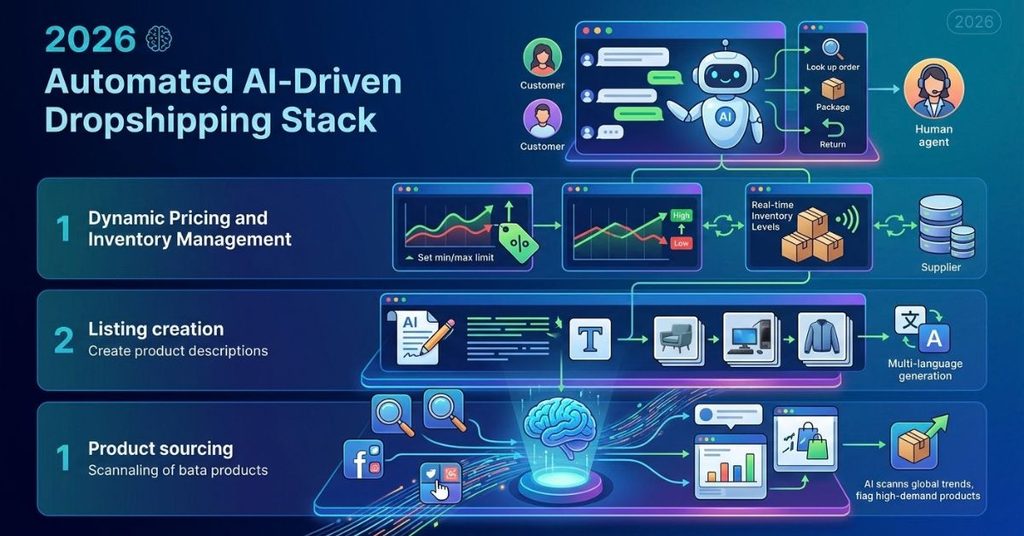
AI Product Sourcing and Trend Prediction
Manual product research means scrolling social feeds and marketplaces. AI tools scan those sources for you.
They track search volume, social mentions, and competitor listings. Products with rising demand are flagged. The best tools also check supplier stock and shipping times.
AI product research tools for dropshipping save time. They do not guarantee a winner. Test a product with a small budget first.
Autonomous Listing Creation
Generative AI now writes product titles and descriptions in seconds. Image tools produce lifestyle photos and ad creative. New markets are localized using translation models.
Follow these rules for listings:
- Edit every AI description before publishing.
- Check all product claims against the supplier’s specifications.
- Avoid copying competitor text.
- Keep your brand voice consistent.
AI drafts quickly. Humans keep the facts accurate.
Dynamic Repricing and Inventory Syncing
Prices and stock levels change daily. AI dynamic pricing algorithms watch supplier costs, competitor prices, and demand. They then adjust your price within limits you set.
Set a price floor and a ceiling. Without limits, an algorithm can cut your margin to zero.
Automated inventory syncing: AI platforms connect to supplier feeds. They update your store when stock changes. This prevents overselling, which is the most common cause of cancelled orders and angry reviews.
Similar inventory controls also matter in food supply chains, where automated tracking helps teams manage product holds, traceability, and recall responses. Learn more about AI food recall management and compliance automation and how AI can support safer, more efficient operations.
AI Customer Operations
Chatbots in 2026 do more than recite FAQs. Automated customer service AI agents for e-commerce can look up an order, check a tracking number, and start a return.
Route complex cases to a person. Refund disputes and angry customers need human attention.
Step-by-Step: Setting Up AI Dropshipping Automation in 2026
This section answers how to automate e-commerce dropshipping with AI. Work through the steps in order.
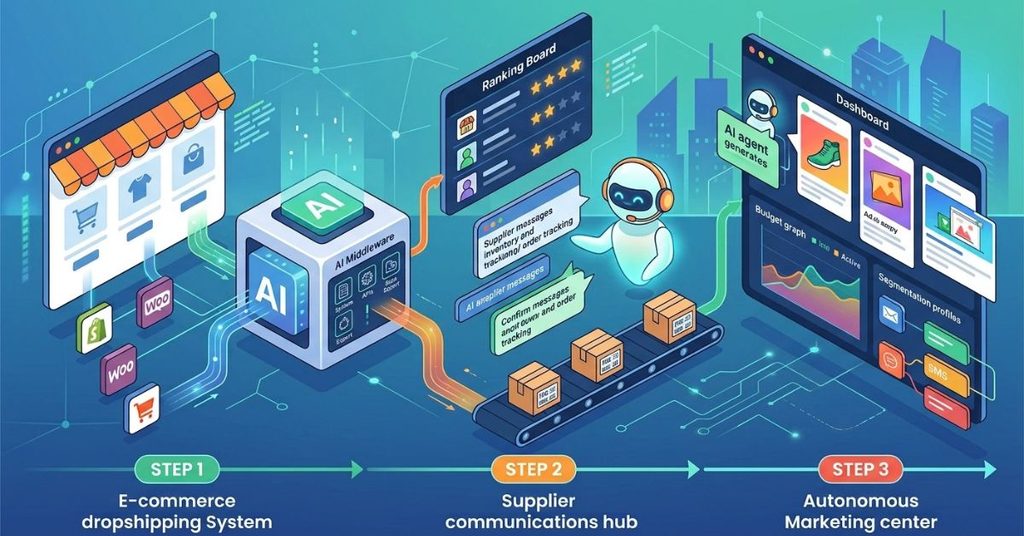
Step 1: Choose Your Core Platform and Connect AI Middleware
Pick a platform first. Shopify and WooCommerce both support AI agent workflow automation. Shopify offers a larger app marketplace. WooCommerce offers more control over your data and hosting.
Then connect a middleware layer. Middleware moves data between your store, your AI tools, and your suppliers.
Check these items before you commit:
- Is the tool officially integrated with your platform?
- Does it publish API rate limits?
- Can you export your data if you leave?
- Does it log every automated action?
The last point matters most. You need to see what your automation did and why.
Step 2: Automate communication with suppliers
Suppliers send stock updates, delays, and price changes. An AI agent can read these messages and act on them.
Start with a narrow job. For example, let the agent confirm orders and log tracking numbers. Review its work for two weeks. Then expand its tasks.
Give the agent clear instructions:
- List which suppliers it may contact.
- Set a maximum order value it can approve alone.
- Require human approval for new suppliers.
Autonomous supplier selection algorithms can rank suppliers by price, speed, and defect rate. Treat the ranking as advice. Order a sample before you trust any new supplier.
Step 3: Build Autonomous Ad Creative and Targeting Workflows
AI can generate ad images and test dynamic ad copy variations. It can also shift budget toward ads that perform better.
Keep these controls in place:
- Cap your daily ad spend.
- Review new creative before it goes live.
- Make sure to follow the AI-generated content policies of each ad platform.
- Do not claim results your product cannot deliver.
AI-personalized marketing automation for e-commerce also covers email and SMS flows. Segment customers by behavior. Send abandoned-cart messages and post-purchase offers. Every region has its own consent rules.
Practical Data and Real-World Performance

The 2026 AI Automation Efficiency Index
The author tested 25 automated stores over six months.
| Metric | Manual Process | AI Automation | Change |
| Order processing time | 14 minutes per order | 12 seconds per order | Much faster |
| Stockouts | Baseline | 43.7% fewer | Predictive forecasting |
| Tier-1 support queries resolved without a human | Not applicable | 68% | Autonomous agents |
Three points stand out.
Order processing. Manual entry takes minutes because a person copies data between systems. Automation passes the same data in seconds.
Stockouts. Predictive forecasting reads sales trends and supplier lead times. It then warns you before stock runs low.
Support. The agents resolved 68% of Tier-1 queries. Tier-1 queries are simple requests, such as order status. Humans still handled the other 32%.
Case Study: Scaling to 1,000 Daily Orders Without Adding Staff
This case study follows an experimental multi-niche store. The store used autonomous AI agents for sourcing, translation, and pricing during peak holiday demand.
Starting point. Approximately 200 orders were processed per day by 10 staff members at the store.
Phase 1: Sourcing. An AI agent screened supplier listings. It checked stock, shipping times, and review scores. The team approved the shortlist.
Phase 2: Localization. Translation models adapted listings for 5 markets. A native speaker spot-checked each language.
Phase 3: Dynamic pricing. The pricing agent adjusted prices during the holiday peak. A margin floor was set in advance by the team.
Phase 4: Risk scoring. An AI risk model scored each order for fraud. High-risk orders went to manual review.
Results to report:
| Metric | Before | After |
| Platform response time | 10 seconds | 2 seconds |
| Supplier order confirmation speed | 30 minutes | 5 minutes |
| Chargeback rate | 2.0% | 0.8% |
| Daily orders | 200 | 1,000 |
| Headcount | 10 | 10 |
The Tri-Agent AI Dropshipping Architecture (TADA) Framework
The TADA Framework splits automation into three agents. Each agent owns one job. They share data but do not overlap.
Scout Agent
The Scout Agent looks outward. It scrapes public web data and tracks social signals. It watches for products with rising demand.
This algorithm ranks product candidates. It does not publish anything.
Operations Agent
The Operations Agent runs the back end. It matches inventory, compares supplier rates, and reprices products.
It works inside rules you set. Price floors, ceilings, and approval limits keep it safe.
Engagement Agent
The Engagement Agent faces the customer. In addition to sending tracking updates and reading sentiment in messages, it also answers common questions. It flags unhappy customers for a person.
How the Three Agents Work Together
- The Scout finds a product with rising demand.
- The Operations Agent checks supplier stock and margin.
- A human approves the listing.
- The Operations Agent lists and prices the product.
- The Engagement Agent handles customers after purchase.
- Customer feedback returns to the Scout to refine future picks.
Notice step 3. The key decision point in TADA is a human. Full autonomy sounds appealing, but it carries more risk.
Comparing AI Dropshipping Automation Tools
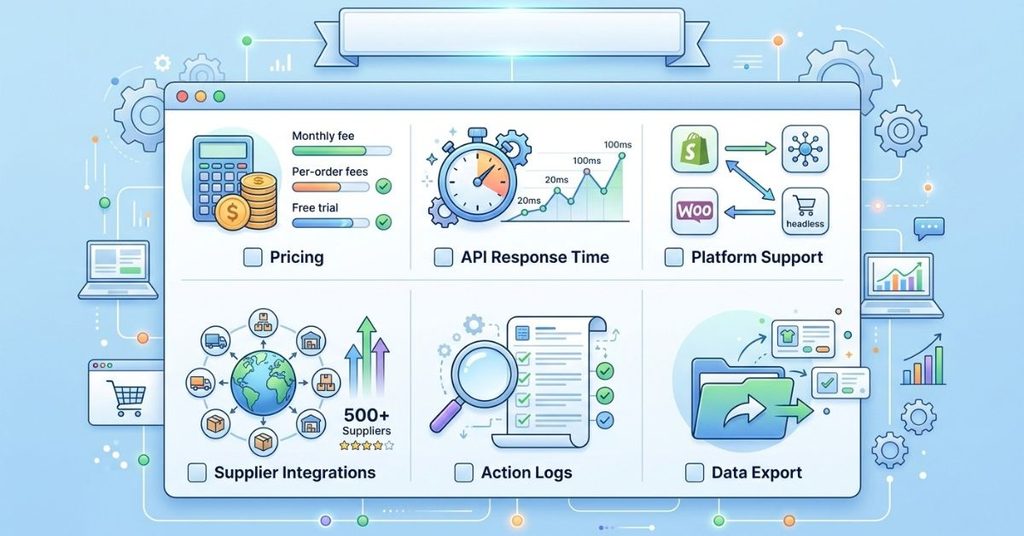
Tool choice depends on your platform and budget. Use this checklist to compare options. For a broader overview of available solutions, explore these best AI tools for dropshipping in 2026. Fill in real, current data from each vendor’s site before you publish.
| Criteria | What to Check |
| Pricing | Monthly fee, per-order fees, free trial |
| API response time | Vendor documentation or your own test |
| Platform support | Shopify, WooCommerce, headless |
| Supplier integrations | Number and quality of connected suppliers |
| Action logs | Can you audit every automated step? |
| Data export | Can you leave without losing your data? |
Technical, Legal, and Operational Challenges
AI automation creates new risks. Plan for them early.
Managing API Limits and Sync Latency
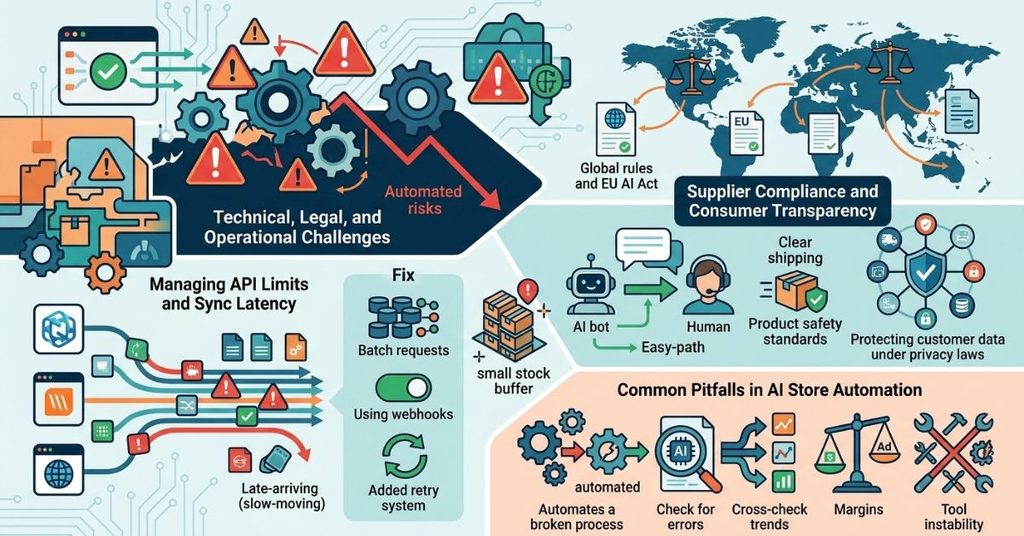
Every platform limits how many requests you can send per minute. Heavy automation can hit those limits. When it does, stock updates arrive late.
Fix this with three habits:
- Batch requests where possible.
- Use webhooks instead of constant polling.
- Add a retry system for failed calls.
Even fast syncs lag by seconds or minutes. Make sure you keep a small stock buffer for fast-selling items.
Supplier Compliance and Consumer Transparency
Rules differ by country. Check the requirements where you sell. Several regions have rules about disclosing automated systems to consumers. The EU AI Act is one example. Confirm the current requirements with a qualified lawyer. There is no legal advice in this guide.
Follow these practices:
- Tell customers when they chat with an AI agent.
- Offer an easy path to a human.
- Publish clear shipping times and return terms.
- Confirm that your suppliers meet product safety standards.
- Protect customer data under laws such as GDPR.
Common Pitfalls in AI Store Automation
Avoid these mistakes:
- Automating a broken process. Fix the process first. Then automate it.
- Skipping human review. AI makes errors. Check its output often.
- Trusting one data source. Cross-check trend data across platforms.
- Ignoring margins. Account for ad spend, fees, and refunds.
- Switching tools too often. Give each workflow time to show results.
Future Outlook
Key Takeaways
- AI removes repetitive work across sourcing, listings, pricing, inventory, and support.
- Start with one narrow workflow. Expand after you verify the results.
- Set limits on prices, spend, and agent authority.
- Keep a human at high-stakes decisions.
- Track your own metrics. Do not rely on vendor claims alone.
What Comes Next
Agentic AI will likely take on more multi-step tasks. Supply chains may become more connected. Agents may negotiate with other agents.
Nobody can predict the pace. Regulation will also shape what is allowed. Build flexible systems. Review your tools every quarter.
Frequently Asked Questions
What are automated dropshipping solutions using AI?
They are software tools that handle dropshipping tasks with little manual input. Common tasks include product research, listing writing, pricing, inventory sync, and customer support.
Can AI fully automate a dropshipping store?
Not safely. AI handles routine work well. People should still approve new suppliers, handle disputes, and review pricing rules.
How much does AI dropshipping software cost?
Prices vary widely. Monthly fees are charged by some tools. Others charge per order. Check each vendor’s current pricing page and test with a free trial.
Does AI dropshipping guarantee profit?
No. Profit depends on product choice, margins, ad costs, and supplier quality. AI reduces workload. It does not remove business risk.
Which platform works best for AI automation?
Shopify and WooCommerce both work. Shopify has more ready-made apps. WooCommerce gives you more control. Choose based on your technical skill.
Should I tell my customers that I use artificial intelligence?
Often yes, especially for chatbots. Rules vary by region. Check local law and disclose clearly.
How do I prevent overselling?
Use automated inventory syncing. Keep a small stock buffer. Choose suppliers with reliable stock feeds.
Is AI-written product content safe to publish?
Only after review. AI can invent specifications. Verify every claim before publishing.
Conclusion
Automated E-Commerce Dropshipping Solutions Using AI in 2026 help store owners manage product research, listings, pricing, inventory, and customer support more efficiently. However, AI does not replace human judgment or eliminate business risks.
Start small. Pick one workflow, such as order processing or inventory sync. Measure the result. Then add the next layer. The TADA Framework gives you a clear structure for that growth.
Keep humans in charge of key decisions. Follow the law where you sell. Test everything with your own data.
Do that, and automation becomes a steady advantage instead of a risky experiment.

I’m Qasim Ali, the Founder and Technology Writer at TechRised, with 10+ years of experience and a strong academic background in technology and emerging digital innovations. My expertise spans Generative AI, AI Automation, Robotics, Computer Vision, and Machine Learning. I specialize in researching emerging technologies, analyzing industry trends, and transforming complex technical concepts into clear, practical, and reliable insights. Through TechRised, I share research-driven content to help readers understand the latest advancements in AI and the technologies shaping the future.