


Introduction
Food recalls cost money, time, and trust. Most plants still handle them with spreadsheets, email chains, and phone calls. That works until a real event hits.
AI recall platforms change the workflow. Their job involves reading supplier documents, linking lots across systems, and identifying problems early. Food safety and quality assurance (FSQA) teams spend less time hunting for records. They spend more time making decisions.
This guide explains how AI-funded startups are building food recall management and compliance automation solutions. It also covers the FSMA 204 rule, a four-stage maturity model, and how to judge vendors.
Why Manual Recall Management Falls Short

The Cost of a Slow Response
A recall starts with a signal. A lab result looks wrong. A customer complains. A supplier sends a warning. Then the clock starts.
Your team must answer three questions fast:
- Which lots are affected?
- Where did they go?
- How much product remains in the building?
Manual systems answer these slowly. Data sits in separate places. Receiving logs live in one file. Production records live in another. Shipping data lives in the ERP. Someone must connect them by hand.
Each hour of delay widens the recall. A broad recall costs more than a narrow one. It also hurts the brand more.
Why Allergens and Documentation Gaps Matter
The FDA sorts recalls into classes. A Class I recall covers products with a reasonable chance of causing serious harm or death. Undeclared allergens appear often in recall reports. Check the latest FDA and USDA FSIS enforcement data before you quote exact shares.
Paper and spreadsheets also create errors. People mistype lot codes. They misfile certificates. They lose a page. Small mistakes become large problems during a recall.
The Regulatory Push: FSMA 204
Section 204 of the Food Safety Modernization Act (FSMA) tightened traceability rules. November 2022 marked the finalization of the FDA’s Food Traceability Rule. Companies that manufacture, process, pack, or hold foods on the FDA’s Food Traceability List are subject to the rule.
The compliance date has moved. Congress directed the FDA not to enforce the rule before July 20, 2028, and the FDA is following that directive. The rule’s requirements did not change. Only the date moved.
The rule centers on three ideas:
- Critical Tracking Events (CTEs): Key steps such as receiving, transforming, and shipping.
- Key Data Elements (KDEs): You record details at each step, such as lot codes.
- The 24-hour rule: The rule requires covered companies to give the FDA their records within 24 hours of a request.
Many large retailers will not wait until 2028. Major retailers and foodservice distributors have already written FSMA 204 requirements into supplier contracts, often with earlier timelines. Your customers may set your real deadline.
What an AI Food Recall Management Platform Does
Core Components
An AI recall platform does four jobs.
- Data ingestion. It pulls records from your ERP, warehouse system, lab tools, and supplier portals.
- Lot tracing. It links ingredient lots to finished goods and shipments.
- Risk flagging. It spots patterns that suggest a problem.
- Workflow control. It starts holds, drafts notices, and logs every action.

How the Software Reads Messy Documents
Plants run on unstructured files. Certificates of Analysis (COAs) arrive as PDFs. Lab reports come as scans. Supplier specs arrive in email.
Machine learning tools extract text and fields from these files. Optical character recognition (OCR) reads the page. A language model then identifies the lot number, test values, and dates. The system compares those values with your specs. It flags any mismatch.
Accuracy varies by tool and by document quality. Ask each vendor to test its software on your own files.
The Role of Funded Startups
Venture-backed and seed-stage companies build many of these tools. They move quickly and focus on narrow problems. Some handle COA extraction. Others handle traceability or environmental monitoring.
Startups carry risk. They may change direction, get acquired, or run out of money. Section 7 shows how to evaluate that risk.
A Four-Stage Maturity Framework
This framework is a planning model. It is not an industry standard. Use it to find where your plant stands today.
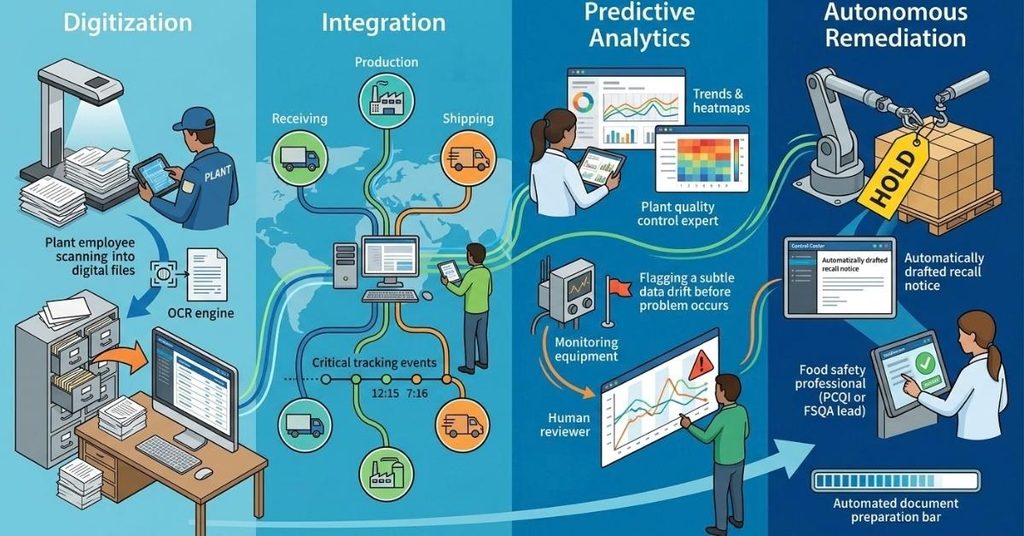
The Four Stages at a Glance
| Stage | Name | What the plant does | Typical tools |
| 1 | Digitization | Converts paper and PDFs into structured data | Document parsing, OCR |
| 2 | Integration | Connects data across systems and captures CTEs continuously | ERP connectors, traceability engines |
| 3 | Predictive Analytics | Detects anomalies before they become failures | Monitoring analytics, trend models |
| 4 | Autonomous Remediation | Triggers holds and drafts notices with human approval | Workflow automation |
Stage 1: Digitization
You start by getting records into digital form. Your team stops filing paper COAs. The software reads them, tags them, and stores them.
This stage pays off quickly. Audit prep gets easier. Instead of spending hours searching for a lot, you can find it in seconds.
Stage 2: Integration
Next, you connect systems. Receiving data flows to production. Production data flows to shipping. Each CTE gets recorded as it happens.
This is the stage that matters most for FSMA 204. You cannot meet a 24-hour records request if your data lives in five places.
Stage 3: Predictive Analytics
Now the software watches for trends. It scans environmental monitoring results and temperature logs. It flags a drift before a result fails.
Treat predictions as prompts. A person must review each alert. A false alarm costs time. A missed alarm costs more.
Stage 4: Autonomous Remediation
At this stage, the system acts. It places inventory on hold while drafting a customer notice and preparing the required regulatory documents.
Keep a human in the loop. Your PCQI or FSQA lead should approve every hold and every outside message. Software can speed up the work. It should not own the decision.
Manual vs. AI-Assisted Recall Performance

Why You Should Measure Your Own Numbers
Vendor claims about speed vary widely. Plant conditions vary more. Product mix, data quality, and system age all change the result.
Run your own test. A mock recall gives you a baseline. Run one now, then run another after any software change.
What to Measure
| Metric | How to measure it | Why it matters |
| Time to full trace-back | Start the clock at the signal. Stop when you list every affected lot and customer. | Shows how fast you can act |
| Recall scope | Compare the product you pull with the product that was truly at risk. | Shows whether you over-recall |
| Mass balance accuracy | Examine the in-hand product against the out-of-hand product. | Shows data quality |
| Labor hours per mock recall | Add up staff hours across all teams. | Shows true cost |
| Records retrieval time | Time how long it takes to produce a full KDE file set. | Tests your FSMA 204 readiness |
Narrower Recalls Save Money
Precise lot tracing shrinks the scope. If you can prove which sub-lots carry the risk, you pull less product. Less product pulled means lower disposal cost, fewer lost sales, and less brand damage.
Do not trust a single percentage from a sales deck. Ask the vendor for customer references. Ask what the plant’s data looked like before the tool arrived.
How AI Automates a Recall Workflow, Step by Step

A fast recall follows four steps. The time each one takes depends on your data.
Step 1: Detect the Signal
The system picks up a trigger. It might be a failed lab result, a supplier alert, a sensor reading, or a customer complaint. It opens an incident and starts a log.
Step 2: Cross-Reference Records
The software searches supplier receiving logs and production records. It maps the suspect ingredient lot to each batch that used it. It then maps those batches to shipments.
This step takes days by hand in many plants. Software can finish it in minutes when the data is clean. The same workflow-based approach is used in AI lead generation automation, where systems connect triggers, data, and follow-up actions.
Step 3: Trigger Holds
ERP and warehouse systems are placed on hold for affected inventory. It alerts the team. It also lists products that have already shipped.
Your quality lead reviews the list and confirms the hold.
Step 4: Draft the Documents
The platform drafts customer notices and regulatory forms. It fills in lot codes, dates, and quantities from your records. Your team edits and approves the drafts. Nothing leaves the building without human sign-off.
A Hypothetical Example of Prevention in Action
Note: This is an illustrative scenario. There is no real customer case here.
The Challenge
A mid-sized plant makes two similar products on one line. One contains almonds. One does not. Changeovers happen several times a day. Operators must swap packaging each time. A mismatch could put the wrong label on a product with an allergen.
The Technology
The plant adds cameras at the packaging station. Software reads each label and checks it against the product code in the ERP. If the label does not match, the line stops. The system places the affected units on hold and alerts the supervisor.
The Outcome to Aim For
A system like this tries to catch a mislabel at the line. Caught there, the error costs a few units. Caught after shipping, it can trigger a Class I recall.
There are several factors that affect the results, including camera placement, lighting, label design, and line speed.
Lessons to Take From It
- Prevention costs less than response.
- Vision systems need a clean data link to your ERP.
- Operators need training on what the stop alert means.
How to Evaluate Venture-Backed FSQA Vendors

Technical and Security Checks
Ask these questions before you sign:
- Does the vendor have a valid SOC 2 report? Ask to read it. Check the report type and the date.
- How does the platform connect to your ERP? Ask for a named customer on the same ERP.
- Who owns your data? Who can see it?
- Can you export all your data if you decide to leave the platform?
- How does the vendor handle model errors? Ask for examples.
Business Checks
Startups carry extra risk. Ask about runway, customer count, and leadership turnover. Compare the vendor with other food recall management software companies before making a decision. Ensure you know what happens to your data if the company closes or is sold.
Vendor Scorecard
Score each vendor from 1 to 5. Weight the rows by what matters to your plant.
| Criterion | What to look for | Score (1–5) |
| Data security | SOC 2 report, encryption, access controls | 5 |
| ERP integration | Proven connector, realistic setup timeline | 4 |
| Document accuracy | Reports and COAs that show strong results | 4 |
| FSMA 204 fit | Supports CTEs, KDEs, and 24-hour record export | 5 |
| Human review controls | Approval steps before any hold or outside message | 4 |
| Reference customers | Plants similar to yours, willing to talk | 3 |
| Vendor stability | Funding, staffing, exit plan for your data | 4 |
| Support | Response times, onboarding help | 4 |
Before a full rollout, run a paid trial. Give each vendor the same test files. Compare results side by side.
Frequently Asked Questions
How does AI help with FSMA 204 compliance?
AI tools collect and link the data the rule requires. They record CTEs, store KDEs, and assign traceability lot codes. They also help you produce records fast. The rule requires you to give the FDA your records within 24 hours of a request. Software does not make you compliant on its own. You still need a written traceability plan and trained staff.
Can AI replace PCQI professionals?
No. A Preventive Controls Qualified Individual (PCQI) carries regulatory responsibility. Software supports that person. It does not take the role. Keep a human in the loop for every hold, release, and regulatory filing.
How long does onboarding take?
It depends on your systems. A plant with clean ERP data and a standard setup moves faster. A plant with paper records and several legacy systems takes longer. Ask each vendor for a written timeline. Ask for customer references who can confirm it.
Does the rule apply to all foods?
No. It applies to foods on the FDA’s Food Traceability List and to foods that contain those items as ingredients. Check the current list before you plan. Some products, such as many dairy items, may fall outside it.
Is the FSMA 204 deadline still July 2028?
Yes, as of this writing. Confirm the date on the FDA’s website before you rely on it. Plans can change, and your customers may ask for earlier compliance.
What should I do first?
Run a mock recall. Time it. Note every place where you waited on a person or a file. Those gaps show you where to invest.
Do AI recall tools work for small plants?
They can. Small plants often gain the most from simple document parsing and lot tracing. Start at Stage 1. Add features as your needs grow.
Conclusion
Recalls test your systems under pressure. Manual processes often fail that test. AI tools help by reading documents, linking lots, and drafting the paperwork.
Not everything needs to be automated at once. Start by measuring your current trace-back time. Place your plant on the four-stage model. Fix the biggest gap first. Choose vendors with proof, not promises.
AI-funded startups are making food recall management and compliance automation more practical, but buyers still need to validate security, traceability, accuracy, and vendor stability.
FSMA 204 gives you more time, but the work is not small. Teams that start now will face the deadline with better data and fewer surprises.

I’m Qasim Ali, the Founder and Technology Writer at TechRised, with 10+ years of experience and a strong academic background in technology and emerging digital innovations. My expertise spans Generative AI, AI Automation, Robotics, Computer Vision, and Machine Learning. I specialize in researching emerging technologies, analyzing industry trends, and transforming complex technical concepts into clear, practical, and reliable insights. Through TechRised, I share research-driven content to help readers understand the latest advancements in AI and the technologies shaping the future.