


Introduction
Search for Chirp Robotics, and you will hit a wall of confusion. Three unrelated projects share the name. One company builds autonomous systems. One university built a swarm robot. One telecom network sells connectivity.
This guide sorts that out first. Then it shows you how to evaluate, test, and deploy Chirp Robotics systems in a factory or warehouse. It is difficult to find public information about this company, so this guide highlights what can be verified and what needs to be verified independently. It invents no numbers.
Understanding Chirp Robotics
What is Chirp Robotics?
CHIRP Robotics Corporation is a seed-stage startup based in Torrance, California. Public profiles list it at about 12 employees. Those profiles describe it as a company working in stealth mode. Its stated aim is to supply modular intelligence and autonomous systems for a range of vehicles and applications.
The company also claims a hardware patent portfolio and proprietary software and algorithms. Independent proof of those claims does not exist in public sources yet. Treat them as vendor statements.
A job listing gives one more clue. It describes an engineer who would run a PCB production line, including stencil printing, pick-and-place, and reflow. That tells you the company works on its own electronics. It does not tell you what products it ships.
Names That Cause Confusion
Before you read any article about chirp robotics, check which Chirp it covers. This table separates the three most common ones.
| Name | What it is | Where it comes from |
| CHIRP Robotics Corporation | Startup building modular autonomous systems | Torrance, California |
| ChIRP robot | Low-cost swarm robot platform for research | Norwegian university research (NTNU) |
| Chirp Network | Decentralized IoT connectivity network | Telecom and DePIN sector |
The ChIRP swarm robot stands for Cheap, Interchangeable Robotic Platform. Researchers built it for swarm experiments. A separate master’s project built a simulator for it.
Chirp Network provides radio connectivity. It has partnered with a robotics network to connect devices. It does not build robots.
Hardware and Software Architecture
There is no hardware datasheet available from the company. So no honest writer can list its sensors, motors, or compute modules today.
What the company does say is that its systems are modular. That word suggests a common intelligence layer that works across different vehicle types. For more details on robot pivot mechanisms and their role in robotic movement, explore our guide to robot pivots.
Three things you should ask the vendor to confirm:
- How much of the stack is hardware, and how much is software.
- Which vehicle platforms the intelligence layer supports today.
- Which interfaces connect that layer to your own systems.
Write the answers down. You will need them in the deployment stages below.
Key Features and Capabilities
What the Company Claims
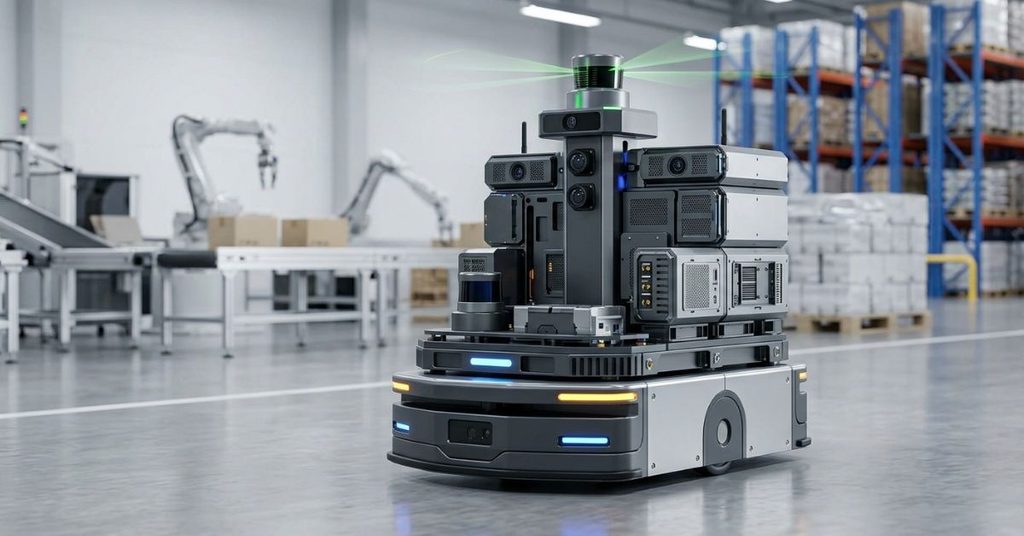
The company positions itself around modular intelligence and autonomy. It targets industrial and commercial uses. It names artificial intelligence integration and control systems as core skills.
That is a direction, not a spec sheet. Buyers need specifics.
What to Verify Before You Buy
Use this table as a checklist. Every row needs a written answer from the vendor.
| Capability | What to ask | Why it matters |
| Sensor array | Which sensors, and how many per unit? | Sensors set how well the robot sees people and obstacles. |
| Navigation | Does it use lidar, vision, or fused data? | The navigation method decides how it copes with changing layouts. |
| AI processing | Are inferences run on robots or in the cloud? | On-board compute keeps the robot working during network loss. |
| Safety protocols | Which standards does the design follow? | Mixed human-robot floors demand proven safety logic. |
| Payload capacity | What is the rated load, and at what speed? | Rated load often drops as speed rises. |
| Operational efficiency | How long does a charge last under load? | Battery life drives fleet size and charging space. |
If a vendor cannot answer a row, mark it as a risk. Assume nothing when filling in the gap.
Performance Benchmarks: How to Test Chirp Robotics
Why You Should Run Your Own Test
No independent benchmark of Chirp Robotics exists in public sources. Any article that quotes exact throughput gains has no data to back it. This guide does not quote any.
You can still produce real data. Run a pilot. The method below works for any vendor.
Methodology: A 90-Day Pilot
Pick one high-throughput zone in a distribution center. Run your current automated guided vehicles (AGVs) there for 30 days. Record a baseline. Then run the new system in the same zone for 60 days. Keep the shifts, order mix, and layout the same.
Two rules keep the test honest:
- Change one variable at a time.
- Log every stop, including stops caused by people.
Key Metrics to Evaluate
| Metric | How to measure it | What a good result looks like |
| Task completion rate | Completed tasks divided by assigned tasks | Rises against your baseline |
| Battery efficiency | Tasks completed per charge cycle | Rises, or holds steady at a higher load |
| Obstruction navigation latency | Seconds from obstacle detection to a new path | Falls against your baseline |
| Mean time between failure (MTBF) | Operating hours divided by failure count | Rises against your baseline |
Define “failure” in writing before the test starts. Otherwise, both sides will argue about it later.
Reading the Results
Plot each metric by week. A single average hides trends. A system that improves in week six tells a different story from one that slips.
Look at the worst days too. Peak-season loads expose weak spots fast. Compare the worst day for each system, not just the mean.
Case Study Framework: Smart Factory Integration
Why This Is a Framework, Not a Story
No public case study of chirp robotics in a factory exists today. So this section gives you the rollout plan to use in your own plant. Treat your pilot as the case study.
Background: A Mid-Sized Electronics Plant
Electronics lines pack many stations into small spaces. Parts are small and valuable. People work close to moving equipment. These traits make electronics a hard test for any mobile robot.
Challenges to Plan For
- Spatial constraints. Aisles are narrow. Check turning space against every route.
- Line handoffs. Robots must deliver parts at the right moment. A late delivery stalls the line.
- Mixed workspaces. People and robots share the floor. Safety zones must hold up under real traffic.
Rollout Plan
- Map one line and its handoff points.
- Record cycle time for four weeks before the robots arrive.
- Install a small fleet on one route.
- Calibrate sensor thresholds and stop zones with your safety team.
- Train line workers before go-live.
- Track cycle time weekly for six months.
- Compare the final figure to your baseline.
Report the change you measure. Report it even if it is small. A true 5% gain beats an invented 28%.
The 5-Stage “Chirp-Fit” Deployment Model
This model gives project teams a repeatable path. It is a planning framework, not a vendor process. Adjust each stage to your site.

Stage 1: Feasibility and Site Assessment
Walk the site. Measure aisle widths, floor quality, and door clearances. Survey the wireless coverage. Dead zones cause stalls.
Ask yourself this simple question: does a robot solve this problem? If not, stop now.
Stage 2: Fleet Sizing and Simulation
Build a digital twin of your layout. Feed it real order data. Test fleet sizes in simulation before you buy hardware.
Simulation errors are cheap. Hardware errors are not.
Stage 3: Hardware and API Integration
Connect the robots to your enterprise resource planning (ERP) and warehouse management (WMS) software. Confirm the interface first.
Map each data flow on paper. Know which system owns each task.
Stage 4: Operational Calibration
Tune the sensor thresholds. Set emergency stop zones with your safety officer. Test with real people walking real paths.
Re-check after any layout change. Calibration is not a one-time job.
Stage 5: Human-Robot Collaboration Training
Train every worker who shares space with the fleet. Teach them what the robots do when blocked. Teach them how to stop one.
Run short refreshers each quarter. Habits fade.
Applications and Use Cases Across Industries
The company says its systems serve industrial and commercial uses. It has not published named deployments. The use cases below show where modular autonomy fits in general.

Logistics and Warehousing
Warehouses move totes, pallets, and carts all day. Autonomous vehicles can handle repeat routes between receiving, storage, and shipping. Gains depend on route density and layout.
High-Precision Manufacturing
Factories need parts at the right station at the right time. Mobile robots can feed lines without fixed conveyors. That helps when layouts change often.
Specialized Inspection and Monitoring
Some sites need regular checks in places that are dull or risky for people. Examples include large storage yards and long corridors. A robot with a sensor payload can run those rounds on a schedule.
Comparing Chirp Robotics to Alternative Technologies
Because specs are not public, this section compares the technology classes. Check each row against the vendor’s real answers.
Chirp Robotics vs. Legacy AGVs
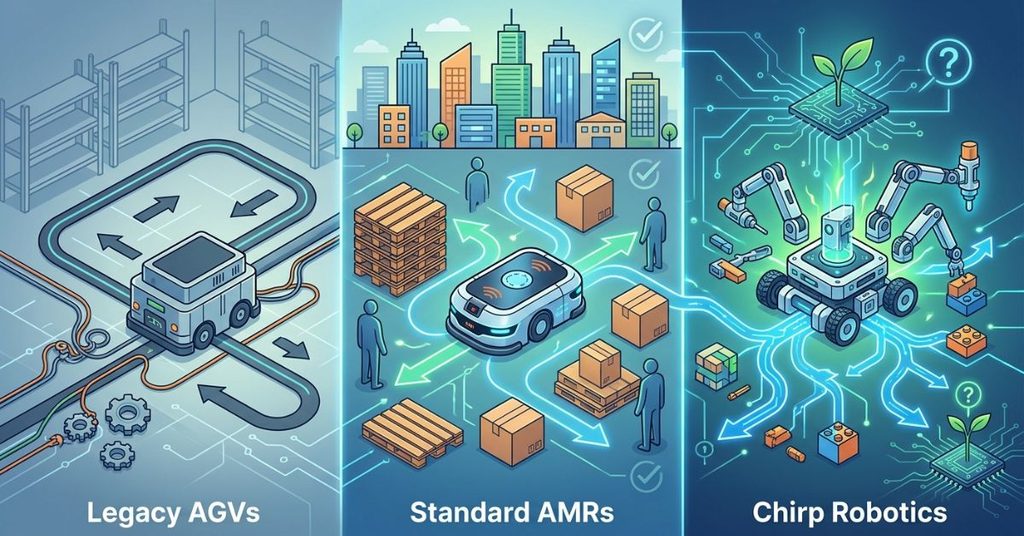
Traditional AGVs follow fixed paths. Those paths use magnetic tape, wires, or reflectors. They work well in stable, repetitive settings. They struggle when layouts change.
A modular autonomous system aims to plan its own routes. That would cut the cost of layout changes. Whether it does so in practice is what your pilot must show.
Chirp Robotics vs. Standard AMRs
Autonomous mobile robots (AMRs) already navigate freely around obstacles. They are a mature product category with many suppliers.
Ask what that something is. It could be price, flexibility across vehicle types, or software openness.
| Factor | Legacy AGV | Standard AMR | Chirp Robotics |
| Path planning | Fixed routes | Dynamic routes | Vendor says modular autonomy |
| Layout changes | Slow and costly | Fast | Ask for a demo |
| Maturity | Very mature | Mature | Early stage |
| Public benchmarks | Widely available | Widely available | None found |
| Vendor support depth | Established networks | Established networks | Ask about staffing |
Safety Standards and Compliance
Safety decides whether a robot can share a floor with people. Know the standards before you talk to any vendor.
- ISO 3691-4 covers driverless industrial trucks.
- ISO 13849 covers the safety performance of control systems.
The company has not published certifications against these standards. Ask for certificates, test reports, and the name of the testing body. Do not accept a verbal assurance.
Frequently Asked Questions
How long does it take to deploy Chirp Robotics systems?
The company has published no deployment timeline. Time depends on your site, your software, and your safety review. Use the five Chirp-Fit stages to build your own schedule. Then ask the vendor to confirm each stage in writing.
What software protocols are compatible with Chirp Robotics?
No public protocol list exists. Many fleet systems use REST APIs, MQTT, OPC UA, or the VDA 5050 standard for fleet communication. Ask which ones this vendor supports. Request a test environment before you sign.
What safety certifications do Chirp Robotics solutions meet?
No public certification record exists. Ask for documents tied to ANSI/RIA R15.08, ISO 3691-4, and ISO 13849. Check that each document names the exact product you plan to buy.
Is Chirp Robotics a public company?
Public sources describe it as a seed-stage private startup. Check current funding news before you commit to a long contract. Early-stage vendors can change fast.
Is Chirp Robotics the same as the ChIRP swarm robot?
No. The ChIRP swarm robot is a research platform from a Norwegian university. It has no link to the startup in Torrance that this guide covers.
Conclusion
Chirp Robotics describes a young company with a clear goal and little public proof. That is normal for a stealth startup. It also means you carry the burden of testing.
Start by confirming which Chirp you are dealing with. Then collect written answers on hardware, software, and safety. Run a 90-day pilot with a clean baseline. Follow the five Chirp-Fit stages. Report only what you measure.
Do that, and you will know whether this technology fits your site. You will also have real data to share, which no public source offers today.

I’m Qasim Ali, the Founder and Technology Writer at TechRised, with 10+ years of experience and a strong academic background in technology and emerging digital innovations. My expertise spans Generative AI, AI Automation, Robotics, Computer Vision, and Machine Learning. I specialize in researching emerging technologies, analyzing industry trends, and transforming complex technical concepts into clear, practical, and reliable insights. Through TechRised, I share research-driven content to help readers understand the latest advancements in AI and the technologies shaping the future.